
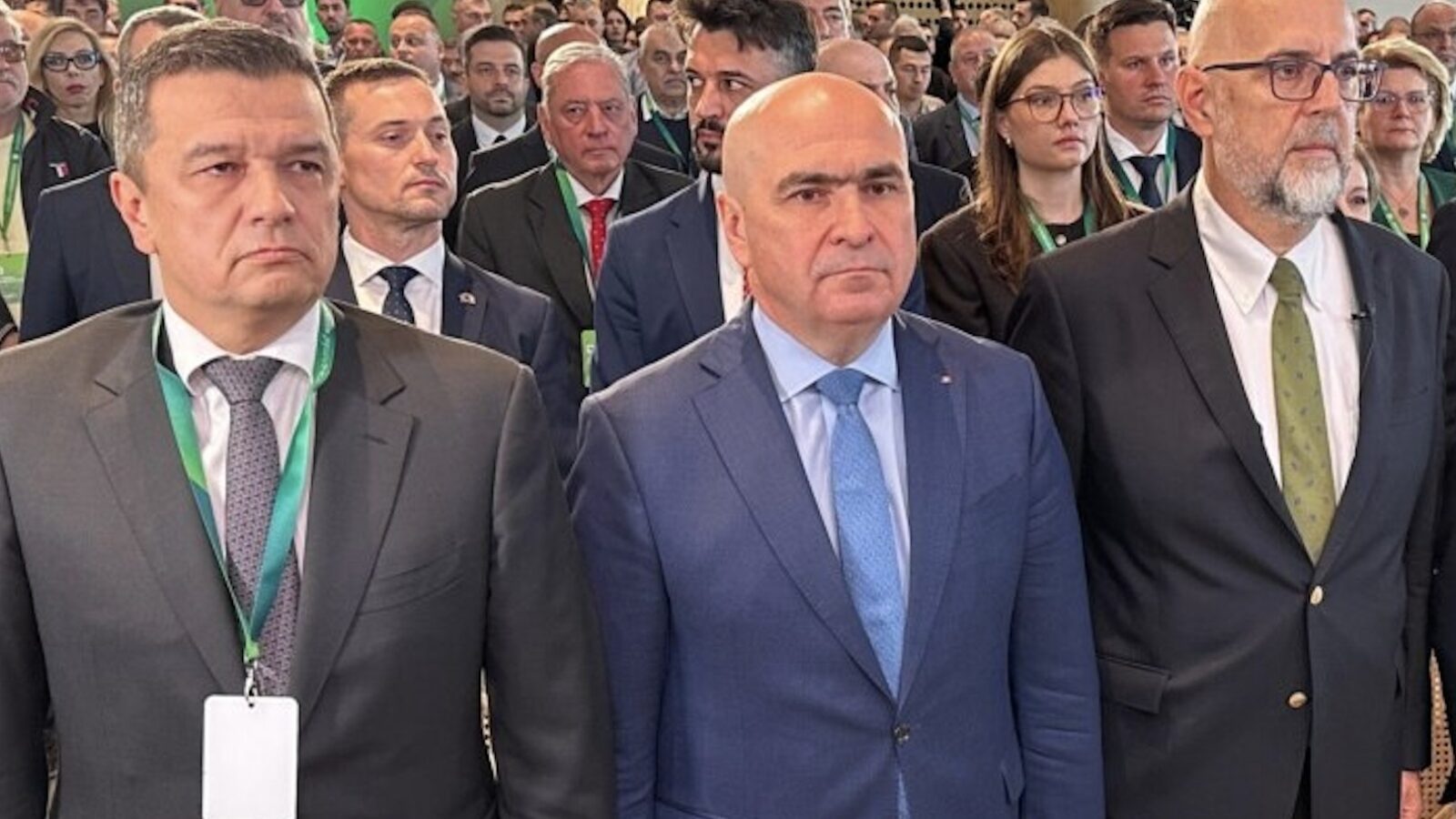
Of all the people the president has nominated for prime minister since Bolojan was ousted, Luca Niculescu has the best chance of getting his government through Parliament. That does not mean his success is guaranteed. The risk that this nomination, too, will fail is high, because of the same red lines that PSD, PNL, USR, UDMR and Nicușor Dan have imposed on themselves for months. Taken together, they amount to a political equation with almost no solution.
The essential difference between Niculescu’s nomination and the previous ones is that another failure would very likely lead to early elections, and could at the same time set off a chain of events pushing Romania into a kind of economic and social danger it has not known since the late 1990s. Since the miners’ march on Bucharest in 1999, to be precise.
The prospect of early elections raises, in theory, the chances that the next government will be confirmed. PSD and UDMR do not want early elections, PNL seems to have understood that it has nothing significant to gain from them, and many unaffiliated MPs or members of small parties fear they will not win a seat in the next legislature. In this context, AUR and USR, the only parties that want early elections, are in the minority.
The arithmetic born of the fear of early elections is not, however, enough to guarantee that a new government takes office. PSD, PNL and UDMR still need to agree with the prime minister-designate on a governing program and on a cabinet line-up that at least does not flagrantly contradict the red lines each of them has boxed itself into. That will be anything but easy, even though there are signs that the leaders of the three parties are more willing than ever to compromise.
On the main lines of the governing program, an agreement is quite likely, despite the aggressive tone of public statements. But the real test, the one that will decide whether there is a Niculescu government at all, will be the names of the ministers.
If PSD decides to stay out of government, every technocrat put forward will be picked apart from every angle in search of suspicious political ties to the other side. If PSD joins the government, it is hard to believe the Liberals will resist the temptation to veto some of the appointments. And since their blacklist of undesirable PSD figures is very long, Luca Niculescu will be hard pressed to find names the Liberals can also accept. And if UDMR joins this merry-go-round of objections and demands, however well the prime minister-designate negotiates, it is hard to believe he will manage to impose a compromise.
The greatest risk for Romania, in case of another failure, does not come from early elections. Though they would be a first for Romania, they are a constitutional and perfectly democratic path, since they send politicians back to the voters. The problem lies in what will happen to the economy, the state and society after the new attempt to form a government is rejected and the president announces the dissolution of Parliament.
The economic shocks we are already feeling – stagnation, the depreciation of the leu, the exorbitant cost of state borrowing, falling consumption, the difficulties of entrepreneurs, the distrust of foreign investors, the risk of a downgrade by the rating agencies – will all get worse. Added to them will be the risk of paralysis in many public institutions.
The president’s warning that without a government with full powers there can be no budget revisions is deadly serious. All of the state’s dysfunctions come to a head at the end of the year. The last quarter has long been the season of the big budget patch-ups. Everything spent without funding in the first nine or ten months gets settled on paper in November and December.
Of course, this is a formula by which the state cheats itself first and then cheats us, shifting the cost of its inefficiency and of the big heists on the budget onto the public debt, that is, into the pockets of each of us. Though deeply immoral and damaging, this mechanism keeps the state apparatus and essential public services afloat.
Without a government with full powers, budget revisions will become almost impossible. Those who think this is good news – a brutal but necessary cut in state spending – are mistaken. Without revisions, the health system and many other public services will become largely dysfunctional. Beyond the chain reaction that unpaid debts of state institutions to private companies will trigger in the economy, the paralysis of the state will have a major impact on society.
Citizens’ trust in the state and in democratic institutions is already at a historic low. Faced with a flood of new problems, people will no longer feel only powerlessness, but also anger.
It will be a very real crisis, not the abstraction it seems in rating agency reports. And we will feel it fully. The patient, told that the hospital no longer has money for tests or cancer treatment. The entrepreneur, unpaid for months by a city hall or a roads department, who will send his employees home. Borrowers, who will have to find more and more lei every month as the currency falls even more steeply. And the huge electricity bill, which energy officials are already threatening us with, will arrive exactly in the months when the state will no longer have the means to compensate for it.
We have grown used to an inefficient and irritating state. Not to a state where no one seems to be at the helm anymore. The last moment of this kind we lived through was when those who had lost money in the FNI investment fund collapse were burning tires in Victoria Square. That is a different thing altogether from the scuffles between Georgescu’s hooligans and the gendarmes. The effect on collective morale will be hard to repair.
Many Romanians will be even more tempted to believe sovereigntist messages, inspired and financed from Moscow. It has long been known that one of the goals of the hybrid war waged by Russia is to weaken citizens’ trust in the state. For a long time, the arguments that fueled this division were false or deliberately exaggerated. The Romanian state was blamed even for things it had not done, and its real problems were inflated to the point of caricature.
But what will happen when the Romanian state itself provides real ammunition for Russian propaganda? When the hospital without medicines stops being fake news spread by anonymous accounts and becomes a reality anyone can witness in an emergency room? When „the state has no money” is no longer a lie but a fact? At that moment, propaganda will no longer need to lie. Amplifying will be enough.
It is precisely against this backdrop that the campaign for early elections will unfold. And the risks are many.
The first is that the entire campaign will be about culprits, not solutions. Every party will accuse the others of the deadlock, and voters will retain only the conclusion that they are all equally to blame. A conclusion that plays straight into the hands of those who have never been in power and who demagogically promise to tear the whole thing down.
The second risk is a bidding war of promises. In a country without money, with a catatonic state, with a deficit under European Commission surveillance and with ever higher interest rates on foreign borrowing, any populist promise will be read by the markets as an alarm signal. Every such signal will be felt instantly in a weaker leu and more expensive debt, that is, in higher prices for everyone.
The third risk is manipulation. We saw in 2024 how vulnerable the electoral process can be to disinformation and outside interference. This time, those who want Romania to come out of the elections weakened will not be starting from scratch. They will have at their disposal a disoriented, frightened and angry society, plus the evidence the state itself will have handed them.
The fourth risk is the street. Protests are legitimate in a democracy, but in a climate of economic crisis and a vacuum of authority they can easily get out of control. It is no accident that I mentioned the 1999 miners’ march. For many of those who managed the crisis at the time, directly and at the highest level, Russia’s involvement was absolutely obvious. Romania was then seeking its path to NATO and the European Union, and Moscow viewed that prospect with irritation. As it did then, Russia will do everything in its power today to exploit a moment of major vulnerability for Romania.
And even if everything goes off without incident, nothing will be solved on election day. Weeks, perhaps months, will pass before a new government is confirmed. The 2027 budget will run on monthly stopgap allocations of one-twelfth of the previous year’s budget, investments will stall, and the new cabinet, whatever its political color, will inherit a country that is more indebted, poorer, angrier and harder to govern than the one today’s leaders refuse to govern.
And after the vote, will the economy and the state do better? Judging by today’s opinion polls, it is not hard to anticipate how international creditors will react when they learn the results. Or what that will mean for state borrowing and for the economy. And whom will the winners of the early elections put in charge of the institutions, when all they offer, day after day, is lies and anti-Western rhetoric?
As for those who would rather bring down the next government too than accept a particular ministerial appointment or give up a sentence in the governing program – have they factored this scenario in? Are they sure early elections are the lesser evil? Are they sure that from elections held in the cold, amid poverty and anger, it is they who will emerge stronger, and not those who live off that anger?
Romanian original: De ce este important ca guvernul Luca Niculescu să fie învestit