
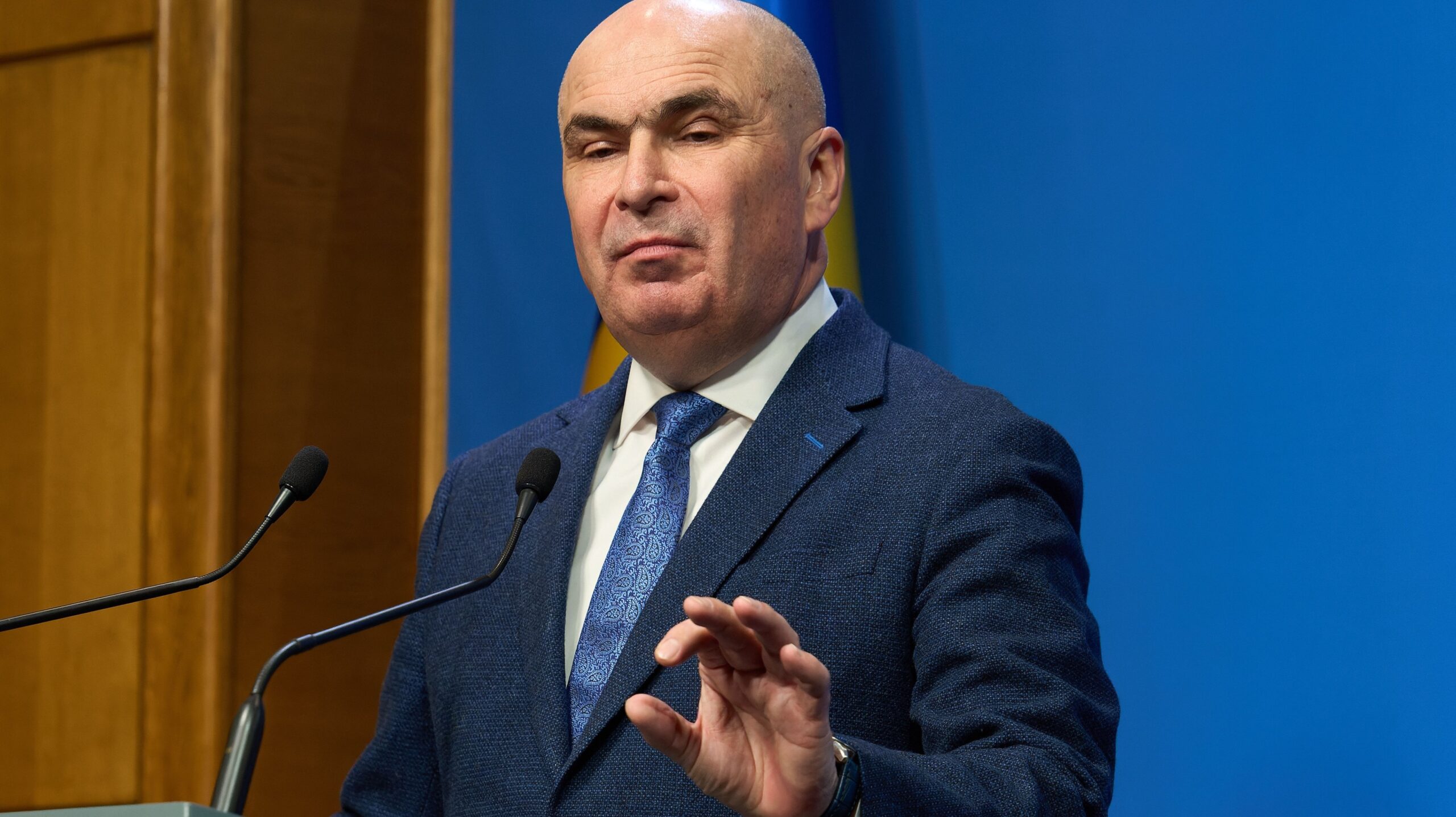
I do not understand why AUR leaders are so happy that they brought Ilie Bolojan down from the head of government. If I were in their place, I would be extremely worried.
Why? Because, without realizing it, they helped Bolojan shatter – “obliterate,” as Trump would say – two of the great fairy tales they have sold Romanians as undeniable truths: that AUR is the only anti-system political force capable of defeating the inefficient and corrupt cross-party establishment, and that they alone are the country’s authentic justice warriors.
The alliance of the “sovereigntists” with PSD against Bolojan, but especially the way he counterattacked, allowed him in just a few weeks to snatch precisely these two themes from under their noses, with a far more convincing discourse. The Dungaciu-Peiu-Simion trio gave the PNL leader a priceless gift: the rhetorical arsenal with which he can bring them to their knees.
On one hand, they impeccably demonstrated their own demagogy. How can you still claim to be anti-system when you vote arm in arm with PSD for a no-confidence motion? How can you still pose as a justice warrior when you bring down a prime minister who had just begun to shine the spotlight on the great black holes of the state?
On the other hand, through the offensive unleashed against him, they gave Bolojan maximum credibility exactly where AUR had built its emotional monopoly: on the idea of fighting the system and corruption. Suddenly, it became obvious that he is the politician truly fighting the old power networks, not those who ally themselves with them.
The significance of this role reversal does not stop at the simple demonstration that the AUR emperors have no clothes.
We are witnessing the first serious crack in the emotional monopoly AUR exercises over the anti-system electorate. For the first time, a significant part of the public sees in someone other than George Simion the expression of revolt against old politics. It is a political earthquake with long-term effects, a tectonic realignment that could lead to the neutralization of AUR and the constellation of pro-Russian factions.
Bolojan’s trust rating exploded from 22% to 30% in the weeks before his dismissal. It is not just a good score. It is a political phenomenon without precedent in Romania. In a climate dominated by anger, cynicism, and fragmentation, this figure positions him as the only real alternative to AUR’s aggressive populism.
Moreover, the spectacular rise in trust in the former prime minister shows something essential: the theme obsessively pushed by AUR and PSD – “Bolojan is selling the country” – did not gain real traction with the majority of citizens. On the contrary. A large part of the public seems to have interpreted the attacks against his reforms not as a defense of the national interest, but as the panicked reaction of a system disturbed by the loss of its privileges.
In other words, the very people who wanted to eliminate him from the game pushed him, without realizing it, into a position of national leadership.
How will Ilie Bolojan exploit this opportunity politically? It is hard to say at this moment, but it would be a loss for Romania if he did not. Of all the ideas circulating lately, the project of building a new political “pole” seems the most likely. And rightly so.
The PNL leader has the chance to dethrone AUR from its position as leader of the political scene by building a center-right, moderate-conservative pole – a rational, credible, and administratively competent alternative to the aggressive populism of the far right.
A clarification. We are not talking about a radical or identitarian conservatism in the style of the new European far right. Bolojan and PNL do not need to renounce the liberal tradition. There are enough precedents in Western politics in recent years in which the center of gravity of the right has shifted toward moderately conservative positions: centrist, fiscally disciplined, attached to the market economy and state reform, but at the same time more cautious toward the excesses of identity politics, the woke movement, and hysterical populism.
This is exactly the space Bolojan can occupy.
For the first time in many years, the Romanian right has the chance to escape the schizophrenia in which it has lived since 1990: either technocratic and lacking political nerve, or loud and hysterical, incapable of producing serious administration. Bolojan seems to be the first politician who can coherently occupy the space between these two worlds.
He has the profile of the kind of moderate-conservative leader who is beginning to dominate Western politics more and more: disciplined, pragmatic, almost obsessive about institutional efficiency, attached to state reform and budgetary rigor, but lucid enough to understand that people no longer vote only for spreadsheets, budget deficits, and PowerPoint slides with reforms.
AUR has lived off monopolizing frustration. Off the idea that only they fight “the system.” Except that the moment they sat down at the same table with the very party that personifies, for millions of Romanians, the old clientelist system, they blew up their supposed moral foundation themselves. You cannot scream for years against the “red plague” and then vote side by side with it just because it serves some petty interests.
The electorate can forgive many things. Strategic hypocrisy, however, rarely.
From here on, everything depends on Bolojan.
He has two options. The first: to turn PNL into the central axis of this new moderate-conservative, center-right pole. But for that he must win a battle harder than the one with AUR or PSD: the battle with his own party.
Because a good part of PNL is part of exactly the establishment Bolojan wants to reform. Years of local deals, sinecures, compromises with PSD, barons elegantly recycled under the label of administrative liberalism do not disappear just because a more serious leader has temporarily reached the top.
If he yields to the pressure of the pro-PSD wing and once again accepts the classic formula of “stability,” this entire moment will evaporate quickly. It will become just another crisis consumed sterilely, in a country that produces political crises at the same speed at which it produces inflation.
If, however, he goes all the way, if he begins a genuine cleanup in the party, if he eliminates the people who turned politics into a family business with public money, then PNL can once again become something it has not been for a very long time: a living party.
There is also the second option. If internal reform hits the wall of the party apparatus, Bolojan could be pushed toward a new construction. With people from PNL, perhaps from other parties as well, with credible technocrats, with high-performing mayors, with a generation that has not had time to be completely contaminated by the transactional reflexes of old politics.
Does it seem unlikely? Emmanuel Macron’s emergence also seemed unlikely before he pulverized the traditional French system.
There is another important consequence here. Such a moderate-conservative pole will inevitably force the Save Romania Union to clarify its ideology. For years, USR tried to be simultaneously a reformist party, culturally progressive, technocratic, anti-system, and urban-corporate. It worked electorally for a while, with limited success. But in a serious competition for rebuilding the right, ambiguity no longer works.
Last but not least, a project built around Ilie Bolojan will also put pressure on Nicușor Dan.
Through his explicit and very vocal support for the new heads of the prosecutors’ offices, the president has already assumed that their performance will inevitably enter the evaluation sheet of his own mandate. In practice, he has tied his political image to the relaunch of the anti-corruption fight and to the efficiency of the judicial system.
If the prosecutors’ offices deliver serious results, Nicușor Dan will be able to claim credit for an institutional reset. If not, the political cost will no longer be transferred exclusively to magistrates or to the Minister of Justice. It will reach Cotroceni directly.
And here a deeper political dimension appears: the pressure exerted by the Bolojan pole on the issue of justice reform could turn into the main battlefield between Nicușor Dan and Ilie Bolojan for the 2030 presidential election.
At the same time, not only anti-corruption will count in the evaluation of the presidential mandate, but also the head of state’s ability to coagulate a functional pro-Western majority capable of administratively stabilizing Romania.
On this front, through the fall of the Bolojan government, Nicușor Dan has already received a black mark. No matter how many tactical explanations are offered, the political reality remains simple: the first important reformist government installed under his mandate was quickly demolished by a PSD-AUR alliance.
In practice, the president can no longer afford another failure.
Precisely for that reason, in order not to turn the political improvisation that will most likely be installed at Victoria Palace into another flop, Nicușor Dan will be forced to do everything in his power so that the next executive delivers at least part of the reforms promised by the dismissed government.
And from this perspective, the existence of the Bolojan pole becomes essential. The pressure coming from this direction could force the president to stop tolerating the slippages of a new government suspected from the start of collusion with “the system” and to use all his institutional levers to impose state reform.
Paradoxically, the very man whom the political system tried to temporarily remove from the game could become the main external engine forcing both the government and the presidency to deliver real results.
And here lies, perhaps, the true stake of this moment. Not the motion. Not the backroom deals. Not the new government. Not the division of ministries. But the possibility that a political force may emerge combining three things Romania has rarely had simultaneously: administrative competence, moral credibility, and political instinct.
We are at a historic moment with enormous transformative potential. For politics. For institutions. For the economy. For Romania as a whole.
For the first time in a very long time, there is a real possibility that hysterical populism can be fought not through sterile moralism or party propaganda, but through performance, order, and legitimate authority.
The cherry on top? If, in the meantime, the Vladimir Putin regime also falls, which would lead to the collapse of its vast influence network in Romania, there really is a chance that, a few years from now, we will look back at this period and realize that, paradoxically, the very moment when everyone thought Romania was returning to chaos was the moment when it truly began to settle into place.