
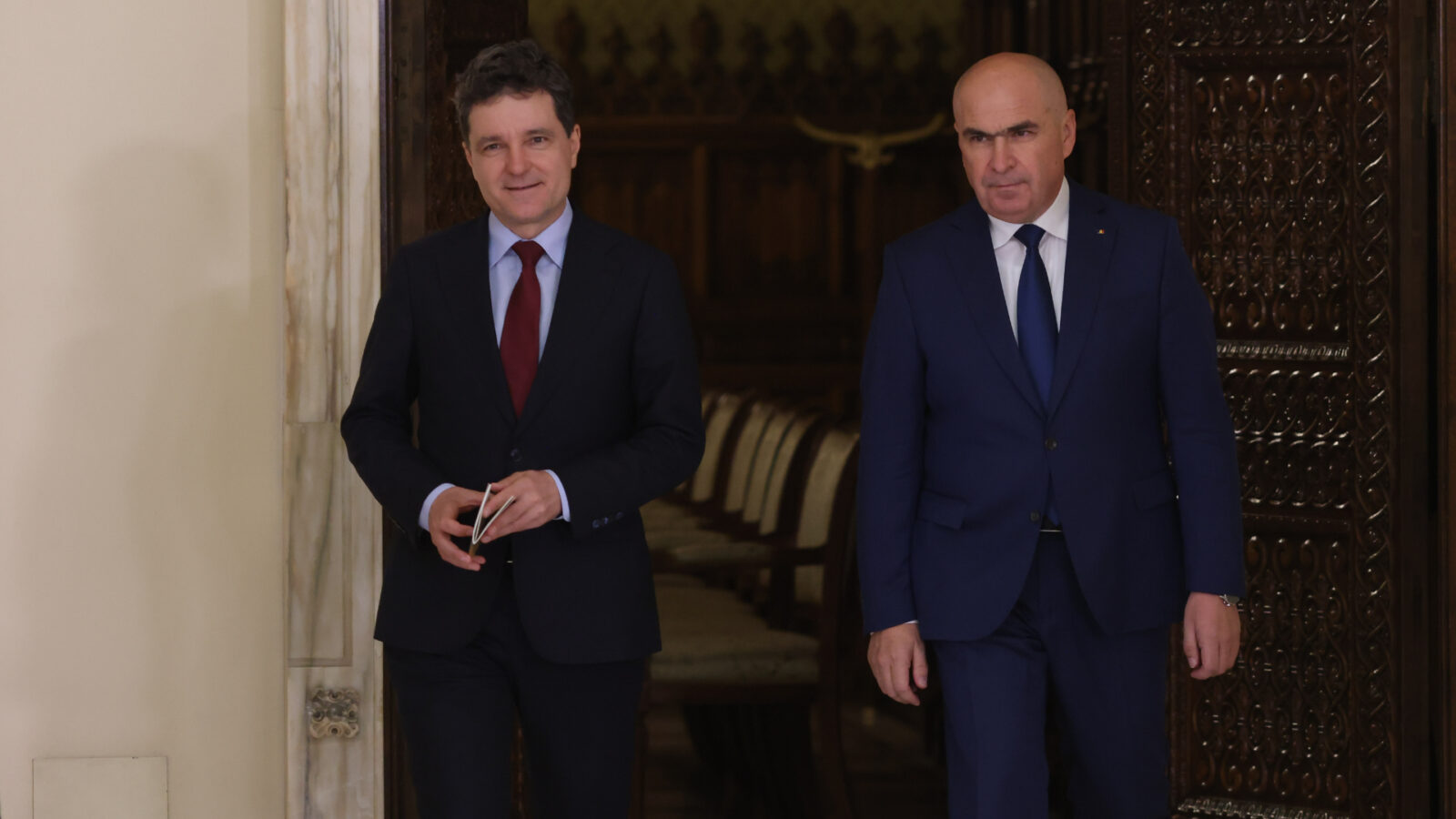
The political crisis we are in is nothing more than a settling of scores between Brussels, Berlin, Paris, and Washington, fought on Romanian soil. Bolojan – “Europe’s man” versus Nicușor Dan – “the man of Trump’s America and MAGA.” I am seeing this interpretive key applied more and more often to the events of recent weeks, from the fall of the Bolojan government to the gaffe committed by the president through his criticism of Europe on its anniversary. It is being used quite directly even by commentators who did not usually venture easily into the swamps of conspiracy scenarios.
Is that really so? What is wrong with simple explanations?
Such as: the Bolojan government did not fall after an order came from Washington. It fell in the Romanian Parliament, through a vote of no confidence, in a domestic political context dominated by tensions within the coalition, but also between prime minister and president; by electoral calculations; by some parties’ fear of paying the cost of reforms; by austerity; by frustration that the channeling of substantial sums from public wealth toward clientelist networks had been blocked. It is a Romanian crisis, produced by Romanian actors, with Romanian instruments, and with Romanian stakes.
Do the serious people who have entered this risky game, with a great many imputations of intent and almost zero certainties, really not realize that it perfectly serves the interests of the sovereigntist ecosystem and especially of its sponsor?
The conspiracy scenario fits perfectly over the narrative the sovereigntists have been trying to impose for years: Romania is no longer led by politicians answerable to citizens, but by intermediaries of foreign powers. Some execute Europe’s orders. Others, America’s. And the only ones supposedly on the side of Romanians are them, the “true” nationalists, the untainted patriots, the last defenders of sovereignty.
Reality, as I decode it, is much more prosaic. The alleged cabals orchestrated by foreigners are most often the scheming of shady characters who are precisely trying to slip between Romanian decision-makers and external partners, posing as people with special access in Washington, Brussels, Paris, Berlin, or other important capitals. They are influence intermediaries, sellers of geopolitical illusions, people who claim they can open doors, transmit messages, arrange contacts, “deliver” the goodwill of an administration or a Western capital. And now is a perfect moment, because the tensions between the United States and the EU provide the ideal pretext for fishing in troubled waters.
In reality, many of them represent no one but their own interests. They are political and economic charlatans who sell the illusion of a special connection with external power in order to place their people in important positions, influence strategic decisions, or get their hands on lucrative contracts. They are the ones who turn Romania’s external partnerships into scenery for domestic deals. And they are also the first to be interested in the public no longer being able to distinguish between the official relationship of the Romanian state with its allies and the obscure networks that parasitize that relationship.
Do you remember Liviu Dragnea and the gang of businessmen fished out of Trump’s orbit who came to Bucharest to make the deal of their lives, promising the PSD leader that the DNA was as good as annihilated and that the president of the United States would save him from prison? What became of them? They ended up in the dustbin of history, while the Romanian-American strategic partnership continues.
Despite this, there are plenty of people who grow rich or gain influence by pretending to speak in the name of America or Europe. All the more so now, when it is easy for them to find enough credulous people to enlist in imaginary geostrategic commandos, on the side of the Americans or of the “Europeans.” And when imposture is confused with real foreign policy, the sovereigntists receive exactly the ammunition they need: they can say that the entire relationship with the West is merely a market of arrangements, commands, and servility.
To paste over the government crisis a geopolitical label of the “United States versus Europe” type is to introduce into circulation, with analytical pretensions, exactly the grammar of sovereigntist propaganda. In reality, for Romania, America and Europe have not functioned, on the major issues of recent decades, as two rival command centers, but as two guarantees of the same historical direction. Implicitly, the scenario in which Romania would have to choose between Europe and the United States is deeply manipulative. It would be an impossible choice.
When Romania had to defend its justice system from the assault of criminal politicians, the messages from Washington and Brussels did not contradict each other. When the anti-corruption fight was attacked, Europe did not say one thing and America another. When the rule of law came under assault, the Americans did not demand its abandonment while the Europeans demanded its defense. On the contrary. For Romania, even under Trump, the shared stake remained the same: a predictable, allied, democratic country, with functional institutions and with a justice system that cannot be brought to its knees at the order of a temporary political majority. Because, just as at the beginning of the strategic partnership, the United States, like Europe, has more to gain from a stable and prosperous country than from a failed and bankrupt one.
That is why saying today that Nicușor Dan is “with MAGA” merely because he is trying to rebuild bridges with the American administration is a serious confusion. Romania cannot afford the luxury of treating the strategic partnership with the United States as an ideological fashion option. The relationship with Washington is neither Republican nor Democratic, neither MAGA nor anti-MAGA. It is one of Romania’s security anchors.
And this anchor has been valued, to different degrees, by different American administrations, by Congress, by the Pentagon, by the State Department, by the diplomatic apparatus, and by the American intelligence community. There is a huge difference between having a pragmatic, strategic, indispensable relationship with the American administration in office and importing the MAGA political culture into Romania. The first is a duty of state. The second would be an ideological option. And for the time being, the attempt to turn the first into the second is either an analytical error or an operation meant to discredit.
Equally superficial is the argument of those who say it would be a mistake to be “on Trump’s side” today because his party could lose the autumn elections. First, no serious state calibrates its strategic alliances according to seasonal electoral bets. Then, because regardless of the configuration of Congress, the president of the United States will continue to retain an important share of his powers in matters of foreign policy, defense, and international representation. But above all because Romania’s pro-American positions are appreciated not only by Republicans. They are appreciated by Democrats as well, and by career officials, and by people in diplomacy, defense, and security who see Romania as an important ally on NATO’s eastern frontier.
When Obama announced in 2009 that he was abandoning the anti-missile shield in Poland and the Czech Republic, nearly all the countries of “old Europe” applauded him. Merkel and Sarkozy said in unison that the shield planned by the Bush administration would have needlessly irritated Russia, and that Obama’s step back “will be appreciated at its true value by our Russian friends.” I do not recall anyone at the time saying that Romania should distance itself from Obama’s America, or Merkel’s Germany, or Sarkozy’s France, because they were playing Russia’s game. In concrete terms, the former American president can be reproached for actions that proved far more harmful to security on the continent than those now imputed to Trump.
Treating the relationship with America as a personal adventure of Nicușor Dan with Trump is downright foolish. Treating the relationship with Europe as a form of Bolojan’s subordination to Brussels is just as foolish. Romania does not have to choose between Europe and America. Romania has everything to lose if it is convinced that it must choose between them.
Moscow does not need AUR to declare that it serves its cause. It is enough for AUR to weaken Romanians’ trust in Western alliances, to turn every NATO or US decision into an act of submission, and to instill the idea that Romania is used by its partners, not protected by them. And when the sovereigntist chorus is joined by credible voices that can never be suspected of pro-Russian sympathies, the effect of conspiracy narratives is truly devastating.
The same trap works in the debate about the SAFE program. We can and must legitimately discuss what contracts will be signed, who produces, where production takes place, how much remains in Romania, what technology transfer we obtain, what role the national defense industry will play, and how we avoid becoming merely disciplined buyers of other people’s equipment. All these are normal questions in a democracy. They are necessary questions.
But demanding transparency is one thing, and turning the SAFE program into yet another proof of “servility” toward foreigners is another. This is exactly the move the sovereigntists make. They take a technical, difficult discussion about defense, industry, procurement, and European security and reduce it to their favorite formula: Romania pays, others win, and Romanian politicians execute orders.
In this story, Bolojan would serve Europe’s interests, Nicușor Dan would serve America’s interests, and the money from SAFE would not help Romania, but influential Western states. The French, the Germans, the Americans all appear, in turn, in the role of the external exploiter. Romania appears, inevitably, in the role of the colony. And the sovereigntists appear, at the end of the scenario, in the role of the only ones with the courage to say “no.”
Except that here a contradiction appears that the conspiracy narrative cannot explain. SAFE is presented by its critics as a program that favors the European defense industry, European companies, European producers, European interests. But then, if the thesis “Nicușor Dan is the man of MAGA/the United States” were true, the president should have opposed the program or at least viewed it coldly, as an attempt by Europe to consolidate its industrial and military autonomy at the expense of American suppliers.
The exact opposite happened. Nicușor Dan not only did not oppose the SAFE program, he was one of its firm supporters. He spoke repeatedly about the need for political consensus to support it, treated the program as a strategic stake for Romania, and convened the parties at Cotroceni precisely to ensure that domestic political turbulence would not derail access to and implementation of this mechanism. In other words, the politician presented by sovereigntist propaganda as “the man of Trumpist America” defended a European program that the same propaganda describes as favorable to European industry.
This is not a minor nuance. It is the central crack in the conspiracy construction. Because if Nicușor Dan were the agent of an American camp hostile to Europe, SAFE should have been a problem for him. In reality, he treated it as an opportunity for Romania. This shows that the stake is not his belonging to a supposed MAGA camp, but the attempt to keep Romania within its natural security logic: in NATO, in the EU, with a solid American partnership and with a Europe capable of developing its own defense industry.
It is an old rhetorical scheme, but an effective one. It works because it starts from a real anxiety: the fear that the Romanian state negotiates badly. Yes, this fear is legitimate. Romania has often negotiated badly. It has missed opportunities. It has bought expensively. It has left local industry outside important contracts. It has signed agreements without obtaining enough in return. But from there to the conclusion that every Western program is a form of plunder and every cooperation with allies is betrayal, there is an enormous distance.
That distance is the space in which sovereigntist propaganda thrives.
But AUR’s positions against SAFE are not merely an internal debate about money, suppliers, and offset. They are proof of a political convergence with Russia’s interest. There is no need to prove an order from Moscow in order to observe the result: when AUR delegitimizes a European defense program, when it presents it as a mechanism of vassalization, and when it moves the discussion from concrete negotiation into the zone of anti-Western conspiracy, it weakens exactly the security consensus Romania and Europe need in the face of the Russian threat.
The same problem appears in the scandal over American gas. If the accusations that former minister Bogdan Ivan lobbied for Romania to buy expensive gas from the United States are confirmed, they must be treated with maximum seriousness. We must see who asked, what they asked for, at what price, through what intermediary, with what justification, and to whose benefit. There is no reason for Romania to accept disadvantageous contracts merely to look good in a diplomatic relationship. The strategic partnership is not a license for bad business.
But here too the essential distinction must be preserved. It is one thing to criticize a possible ill-advised, non-transparent, or disadvantageous procurement. It is another to turn the episode into proof that all parties, except the sovereigntists, serve foreign interests. It is one thing to say: this contract must be checked. It is another to say: Romania is being sold to America. The first statement is correct. The second is fuel for AUR propaganda.
Because this is exactly where the sovereigntists want to take the public: to the conclusion that neither Europe nor America are partners, but masters. That no agreement is negotiation, but submission. That no contract is public policy, but betrayal. That no pro-Western politician can act in Romania’s interest because, by definition, he is someone else’s man.
This logic is toxic. And it is toxic not because the West is infallible. It is not. Western states pursue their own interests. Western companies want contracts. Western governments defend their industries. America defends its economic interests. The United States, France, Germany, Italy all do the same. No one comes to give us geopolitical gifts out of generosity.
But precisely for that reason, Romania needs politicians capable of negotiating hard inside alliances, not politicians who shout from outside them. It needs people who know how to use EU membership and the partnership with the United States to obtain more for Romania, not people who confuse any difficult negotiation with proof of colonization.
This, in fact, is where the great difference lies. A mature state does not defend its sovereignty by isolating itself from allies, but by negotiating intelligently with them. Not by refusing strategic programs, but by entering them with clear objectives. Not by turning every discussion about defense, energy, or justice into a referendum on “foreigners who command us,” but by asking, concretely: what does Romania gain, what does Romania lose, who is accountable, who checks, who produces, who pays, and who benefits?
Romania has had the most to gain when it followed, even against its internal reflexes, the direction recommended by its Western partners. Without European and American pressure, the anti-corruption fight would have been much easier to suffocate. Without Western conditionalities, justice reform would have been postponed indefinitely. Without the United States and the EU, Romania today would be in a gray zone, at the edge of a region in which Russia has already shown what it does to states left alone between empires.
Of course, the West did not save us from all evils. It did not build our highways for us. It did not clean up our administration all the way. It did not make our parties more responsible. It did not rid us of imposture, clientelism, mediocrity, and corruption. But it offered us the framework in which these things can be fought. It offered us rules, pressure, money, security, a market, standards, and direction. And every time Romania tried to leave this framework, it did not become more sovereign. It became more vulnerable.
This is the great intellectual fraud of sovereigntism: it confuses dependence on rules with the loss of sovereignty. It confuses alliances with submission. It confuses partnerships with occupation. It confuses negotiation with betrayal. And then it offers to fix everything through a return to a vague “national interest,” shouted hysterically but never seriously defined.
In reality, Romania’s national interest is not to choose between Europe and America. It is not to cut bridges with Brussels in order to prove it is not a colony. It is not to sabotage the relationship with Washington in order to show it is not Trumpist. The national interest is to remain solidly anchored in both relationships and to use them more intelligently than it has so far.
If we stray from this imperative and begin juggling conspiracy scenarios, we enter AUR’s playing field. And on this field, the sovereigntists win even when they are wrong. They do not need to prove that they can govern. They do not need to explain how they would defend Romania without NATO, how they would finance the economy without the EU, how they would modernize defense without Western industry, how they would guarantee energy security without external partnerships. It is enough for them to repeat that all the others belong to foreigners, while they alone belong to Romanians.
This is the most profitable lie of the moment. And precisely for that reason it must be rejected without hesitation.
There is no Bolojan Romania commanded by Europe and no Nicușor Dan Romania commanded by America. There is a Romania that is trying, with all its weaknesses, to remain in the Euro-Atlantic world. And there is an imaginary Romania, built by the sovereigntists, in which all allies are enemies, all partnerships are chains, all contracts are plunder, and the only salvation comes from those who need Romanians to stop trusting anyone.
The first Romania has problems, but it has a future. The second has only frustrations and anger. But frustrations and anger are no substitute for security, prosperity, or the rule of law.