Romania is sitting on a powder keg.
The sense of frustration fueled by the way the justice system has slipped back into the Adrian Năstase-Rodica Stănoiu-Ioan Amărie era is layered explosively over the effects of an economic crisis felt almost everywhere, but barely visible in the statistics. A crisis that could have been avoided if the pre-election spending spree rubber-stamped by Ciolacu and Ciucă had been kept, at least somewhat, within reasonable limits. This Molotov cocktail largely fueled the rise of Călin Georgescu and the so-called sovereigntist parties.
The good news is that Georgescu, Simion, Șoșoacă, and the rest of the Putinist menagerie are beginning to deflate. The bad news is that tension in society continues to rise. Nor could it be otherwise as long as the fiscal burden presses harder and harder on the middle class, while not a day passes without our learning that the only ones immune to austerity are precisely those who should feel it the most, because they bear a large share of the blame: politicians, public officials, and magistrates.
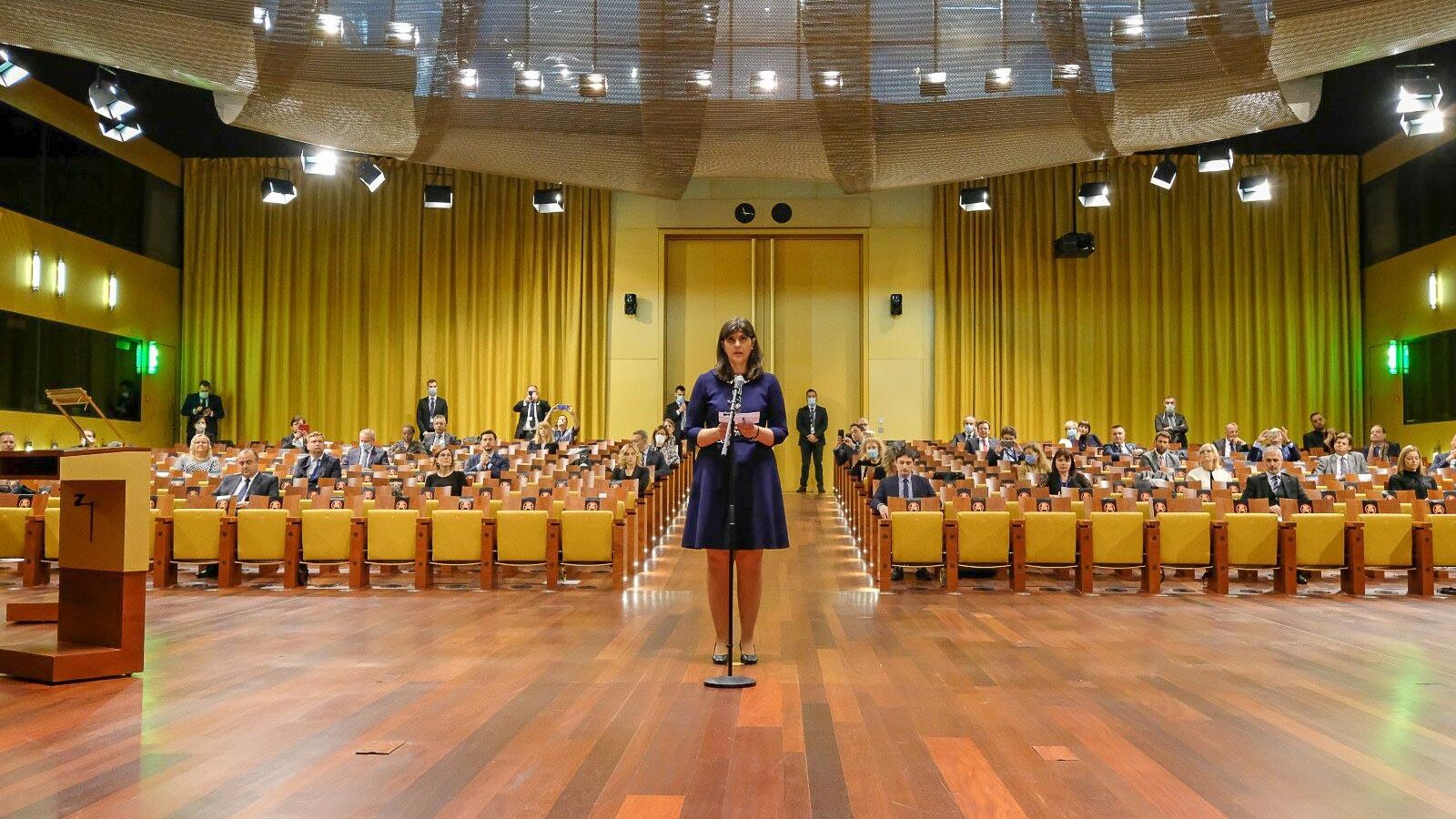
It is no surprise that, a few days after 100,000 euros – loose change, probably – were found in the office of a prosecutor in Constanța, a new interview with Laura Codruța Kovesi generated enormous attention.
It is hard to believe many people are indifferent to whether the former head of the DNA and of the General Prosecutor’s Office is preparing to return to Romania in a position, formal or informal, that would allow her to have a say in the direction of justice in Romania.
The vast majority can hardly wait. As was clearly visible in the rise in Bolojan’s trust rating after he turned on the light in the pantry, the thirst for justice is at its peak. Most Romanians long for heroes willing to wrestle with “the system.”
The rest?
Some are terrified: “What if the Binomial comes back to life? What if they start the wiretaps again? What if they start looking again into our accounts and villas?”
Some are outraged: propaganda carried out for years by television stations turned into shields in defense of their owners is not easily forgotten.
Others are disoriented: how are they to reconcile the success of certain “justice-seeking” documentaries with the reality that the former head of the DNA, whom they angrily accused of abuses, is the one who personifies, in the collective imagination, the very idea of justice? It is complicated to carry principles up and down the stairs after a lifetime spent playing three-card monte with them, depending on personal and well-paid interests.
The interview Laura Codruța Kovesi gave to G4Media offers hope to the first category and reasons for concern to the latter.
Her statements speak about corruption at a different level. It is no longer just about domestic corruption, rigged public contracts, or local politicians, but about cross-border networks, shell companies, VAT, European funds, ports, customs, and organized crime.
The central message is simple: fraud is no longer artisanal, but industrial. And the state, if it remains slow, fragmented, and bureaucratic, loses from the start.
Kovesi insists on an idea that should make every European government uncomfortable: European money has become a major target for organized groups. We are not talking only about small procurement irregularities, but about mechanisms built specifically to extract money from public budgets.
Reuters recently reported that, according to Laura Codruța Kovesi, Europe loses around 50 billion euros annually through tax and customs fraud, while some files investigate networks stretching from China to at least 14 EU member states.
This is, in fact, the great paradigm shift. Corruption can no longer be treated merely as a moral lapse by an official or as a problem of “integrity.” It is a parallel economy. It has logistics, lawyers, accountants, phantom companies, hauliers, intermediaries, consultants, and institutional protection. If in Romania in the 2000s and 2010s the public discussion was dominated by the question “who took the bribe?”, in today’s Europe the more important question becomes: who controls the network?
In this sense, Kovesi’s statements about the European Public Prosecutor’s Office have an almost technocratic note, but the stake is profoundly political. The EPPO is not just a new institution, but one of the EU’s first answers to an uncomfortable reality: European funds move across borders, while national investigations often remain trapped within borders. When the money leaves one state, the companies are in a second, the accounts in a third, and the real beneficiaries in a fourth, a purely national prosecutor’s office arrives too late or does not arrive at all.
Recent cases confirm the scale of the problem. Associated Press reported the arrest of 22 people in Italy, Austria, Romania, and Slovakia in a case concerning the diversion of approximately 600 million euros from post-pandemic European funds. The money came from the European recovery mechanism, and the EPPO investigation targeted an alleged criminal organization that had supposedly created fictitious companies to obtain non-reimbursable grants. The Financial Times described the same case as an alarm signal regarding the vulnerability of the European recovery fund, worth around 800 billion euros in total.
Here lies one of the most important ideas underlined by the former DNA chief: fraud involving European money is not an accounting problem, but a democratic one. Every euro stolen from recovery, infrastructure, agriculture, or digitalization funds does not vanish into a vacuum. It is missing from a hospital, from a road, from a school, from a water network, from a support program for real companies. That is why her discourse is not only about punishing the guilty, but about citizens’ trust in the state and in the European Union.
Another important point is the way Kovesi speaks about corruption as the infrastructure of fraud. Major schemes do not function only through forged paperwork. They need complicities: officials who close their eyes, formal controls, corrupt customs officers, authorities that do not ask questions in time. In Greece, Reuters reported that the EPPO investigated a customs and VAT fraud scheme with estimated losses of more than 800 million euros, and Kovesi emphasized the role of corruption in such mechanisms. The Financial Times described the same type of investigation as an operation that led to the seizure of thousands of containers and the discovery of undervalued imports designed to avoid taxes.
This is also where her firm tone on the independence of prosecutors comes from. A prosecutor’s office investigating fraud with stakes of hundreds of millions of euros cannot depend on the political goodwill of those who may be, directly or indirectly, beneficiaries of the system. In Kovesi’s logic, independence is not a privilege, but a condition for an investigation to reach the end.
For Romania today, but especially for what comes next, the most interesting part is probably the implicit comparison between the old anti-corruption fight in Bucharest and the new anti-fraud fight in Luxembourg. At the DNA, Kovesi became the symbol of the confrontation with the local mafia. At the EPPO, the stake was colder, but broader: protecting the European budget. The difference is that, at the European level, corruption no longer has only the face of the mayor, the minister, or the local baron, but also that of the trading company, the importer, the consultant, the group that knows how to exploit the differences between national laws.
At bottom, Laura Codruța Kovesi’s statements outline the image of a Europe that has created extremely generous financial instruments, but is still learning how to defend them. Kovesi’s message is uncomfortable, as it often was in Romania, precisely because it leaves no room for decorative optimism: fraud is fast, adaptable, and transnational. Public institutions are slow, cautious, and often fragmented. If this speed gap is not reduced, organized crime will continue to treat the European budget as a market.
Her conclusion can be summarized as follows: it is not only the stolen money that is missing, but also the ability of states to understand that today’s thieves no longer resemble yesterday’s. And Europe, if it wants to defend its projects, must first defend its money.
Instead of resignation, Kovesi signals that her public appearances will be more than a balance sheet of her mandate at the European Public Prosecutor’s Office. They signal, rather, the preparation of a launchpad for the next stage of her career, as I announced in the editorial “Kovesi Returns.”
The former head of the DNA does not speak like a withdrawn figure defending her past. She is not announcing her future, but she is preparing it.
She is no longer only the magistrate who polarized Romania in the previous decade, but the European prosecutor who has seen corruption from a continental angle. If she returns, she returns with a different weight, a different network of validation, and a much broader institutional vocabulary. She is already an institutional actor defining her next battlefield.